

CT Senate Candidate Joe Kelly Engages with Liberal Greenwich Voting Mom
Updated: Aug 23
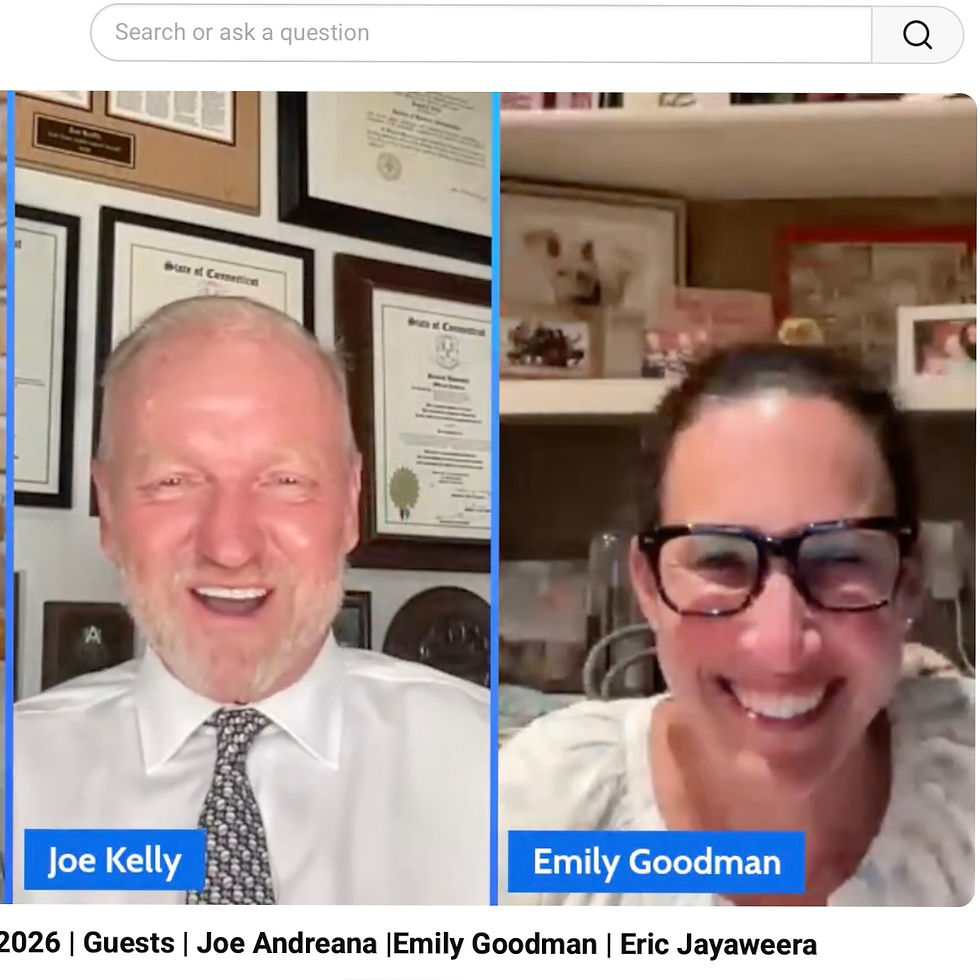
Joe Kelly, a resident of Mead Point in Greenwich, CT, is running on the Republican ticket for State Senate District 36 (covering Greenwich, North Stamford, and New Canaan). Currently a member of the Greenwich Board of Estimate and Taxation (BET), past Chairman of the Greenwich Board of Education (BOE), and active local athletic coach, Kelly is running an energetic campaign—including publishing his own podcast interviews to reach voters.
On a recent podcast episode, candidate Kelly hosted Emily Goodman, a resident of Riverside and the co-founder of the liberal-leaning Greenwich Voting Moms network. Goodman, an attorney focused on digital assets and cryptocurrencies, launched the network and newsletter in 2020 to act as a unified voice for public school parents in Greenwich.
According to Goodman, the Voting Moms are "non-partisan." They maintain a singular focus: supporting "moderate" candidates who prioritize public school funding over candidates she labels as fiscal conservatives or "far right." Armed with a robust mailing list of public school families, the Voting Moms have been very effective in mobilizing local voters to back their recommended "bipartisan candidate" slate.
Key Takeaways from the Interview
Candidate Kelly expertly maneuvered through the discussion. However, the exchange highlighted a fascinating contrast between a singular focus on supporting public school spending and the broader economic realities Kelly says are facing Greenwich residents:
Navigating Party Labels: When asked by Goodman what type of Republican he is and whether he is influenced by the "far right," Kelly emphasized autonomy, stating that while the party nominates him, he answers directly to the voters rather than party machinery.
The Housing Mandate Debate: Addressing the contentious 8-30g state housing statute, Goodman questioned how to maintain workforce housing for local teachers, firefighters, and police. She hoped to see a "bipartisan" solution here. Kelly agreed that workforce housing was important, while pushing back against the top-down housing laws enacted by our legislators in Hartford, insisting that local communities know best.
School Budgets vs. Legal Fees: Goodman pressed Kelly on why the town spent an estimated $500,000 on Board of Education litigation while simultaneously cutting popular paraprofessional positions. Kelly responded by advocating for middle ground and expressing disappointment over past board dynamics, noting that legal battles on both sides ultimately benefit no one.
Taxes and Cost of Living: Goodman asked about tax incentives needed to keep business in Connecticut. Kelly answered by sharing his personal experience of getting hit with a 7% tax rate upon selling a business, arguing that Connecticut needs to lower its state tax rates from around 7% down to 4% or 5% to stop losing residents and entrepreneurs to low-tax states like Florida or Texas.
School Rankings and Real Estate: Goodman expressed surprise to learn that Greenwich High School was recently ranked number two in the state. Kelly credited the community's strong capital investments in public schools—linking his past BOE leadership to this result and recognizing that strong good schools help create strong real estate demand.
Property Taxes and the Mill Rate: Goodman questioned how to justify Greenwich's uniquely low mill rate (property tax rate), one of the lowest in the state. She suggested that a binary focus on mill rates does not serve the town well. Goodman said that our property taxes have only "crept up a little bit," but seemed unaware that average property taxes in Greenwich this year actually rose roughly 6%, placing a heavy burden on residents outside the insulated school budget bubble. Kelly pointed to high CT taxes and spending being a part of the affordability crisis in the state.
Local Infrastructure: The conversation wrapped up with lighthearted local priorities, touching on much-needed athletic field expansions for older youths, the future Strazza Field development at Hamill Rink Park, and calls to turn on the lights for night games at Cardinal Stadium.
Between the Lines: While single-issue advocacy groups remain hyper-focused on school budgets, athletic fields, and localized perks, a glance at the recent jump in your property tax bill and the dense high rise affordable developments going up around you in Greenwich—as mandated by the Democratic super-majority in Hartford—reveals the urgent need for broader change in State leadership.